How to Respond to Negative Reviews as a Tradie (Without Making It Worse)
Your heart drops. One star. "Worst tradie I've ever used." It feels personal. But how you respond matters far more than the review itself — and most tradies get it completely wrong.
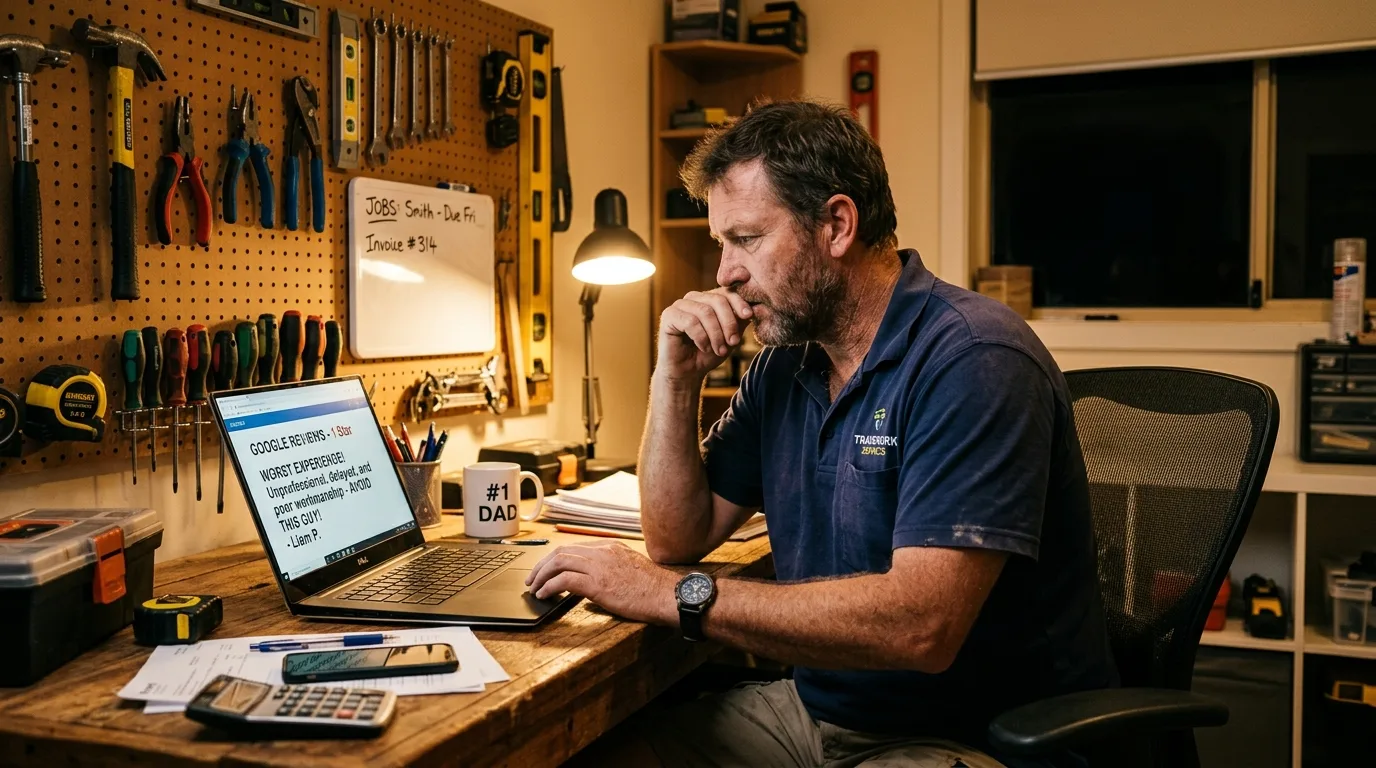
Your heart drops. One star. "Worst tradie I've ever used. Didn't finish the job, left a mess, won't return calls."
It feels personal — because it is. You work hard. You take pride in what you do. And now some stranger has taken a sledgehammer to your reputation in 30 words or less.
Here's the thing: every tradie gets a negative review eventually. The ones who build bulletproof reputations aren't the ones who avoid bad reviews — they're the ones who know exactly how to respond to them. A well-crafted response to a bad review can actually win you more customers than the original review loses you.
For the full picture on building your review strategy, read our guides on Google reviews for trade businesses and how to get more 5-star reviews consistently.
Why Negative Reviews Aren't the End of the World
Before you fire off a defensive reply, take a breath. Negative reviews are far less damaging than most tradies think — and how you respond can flip the narrative entirely.
The data tells a clear story:
The silver lining? A mix of reviews actually looks more trustworthy than a perfect score. A business with 50 five-star reviews and zero negatives can look suspicious — like the reviews are fake. One or two genuine 1-star reviews, handled professionally, make your positive reviews more credible.
The real damage isn't the bad review. It's leaving it unanswered — or worse, responding badly.
Remember who you're really writing for. When you respond to a negative review, you're not just talking to the reviewer — you're talking to every future customer reading your profile. Your response is a public audition for how you handle problems.
The 5-Step Response Framework
Most tradies either ignore negative reviews entirely, or they go on the defensive and make things ten times worse. Neither works. Use this 5-step framework every single time:
1. Breathe
Wait 24 hours. Never respond angry. Sleep on it.
2. Acknowledge
Show you've read and understood their experience.
3. Apologise
Empathise — even if you don't fully agree with the complaint.
4. Action
Offer to resolve it offline. Give a direct contact.
5. Invite Back
Close by expressing you'd welcome the chance to make it right.
Five steps, every time — regardless of how unfair the review feels
Step 1 — Breathe: Never respond in the moment. A reply written in anger will cost you far more than the original review. Give yourself at least a few hours — ideally overnight. You'll write a much better response from a calm headspace.
Step 2 — Acknowledge: Use the customer's name if visible. Reference the specific concern they raised. This shows you've actually read the review, not just fired off a generic copy-paste.
Step 3 — Apologise: You don't have to admit fault — but you can always apologise for their experience. "I'm sorry to hear your experience didn't meet the standard we hold ourselves to" is both honest and empathetic.
Step 4 — Action: Always take the conversation offline. Include your direct number or email. This stops a public back-and-forth and shows other readers you're serious about resolving it.
Step 5 — Invite Back: Close warmly. Something like "We'd genuinely welcome the opportunity to make this right" shows confidence and goodwill — and it's visible to every future customer reading your profile.
Keep it short. Two to four sentences is the sweet spot. Long, essay-style responses look defensive. Brevity signals confidence and professionalism.
Good Response vs Bad Response
The difference between a response that wins customers and one that drives them away is often just tone and structure. Here are four real-world scenarios — compare the bad response to the good one:
| Scenario | Bad Response | Good Response |
|---|---|---|
| Price higher than quoted | "Our quote was very clear. If you'd read it properly, you'd see the extra charges were justified. Not our problem." | "Hi [Name], we're sorry the final cost wasn't what you expected. We'd love to walk through the invoice together — please call us on [number]." |
| Job took longer than expected | "We were waiting on materials — there's nothing we can do about supplier delays. This review is unfair." | "Hi [Name], we sincerely apologise for the extended timeline. Delays are frustrating regardless of the cause. Please reach out at hello@[business].com.au so we can discuss this further." |
| Complaint about workmanship | "We've been doing this for 15 years. The work was done correctly. You clearly don't know what quality looks like." | "Hi [Name], we take quality very seriously and we're disappointed this missed the mark. Please call [name] on [number] so we can arrange a time to review the work." |
| Suspected fake or competitor review | "This review is fake. We've never worked for anyone by this name. Complete lies." | "Hi, we've reviewed our records and can't locate a job matching your details. Please contact us on [number] and we'll look into it immediately." |
Every response above is being read by future customers — not just the original reviewer
Notice the pattern in every good response: no defensiveness, no blame, always a path offline, always professional. Even when the reviewer is completely in the wrong.
Never argue publicly. Even if you're 100% right, a public back-and-forth makes both parties look bad. You will never win a public argument with a customer — even if you're factually correct. Always move it offline.
What a Professional Response Looks Like
Here's a real-world example of a 1-star review handled professionally — and why it actually builds trust with every future visitor who reads it:
No defensiveness, direct accountability, personal contact offered, signed by the owner
A response like this tells every future customer: this business takes responsibility, communicates professionally, and genuinely cares about getting it right. That's worth far more than a perfect 5.0 star average.
Sign your responses. A response signed with your actual name carries 10 times more weight than a generic "Thanks, The Team" sign-off. It shows a real person is behind the business — and that's exactly what customers want to see.
3 Response Templates You Can Use Today
Copy these templates, personalise the bracketed fields, and you'll have a professional response drafted in under five minutes. They work across plumbing, electrical, building, roofing, and any other trade.
For more on building a consistent stream of 5-star reviews to outweigh the occasional negative one, read our guide on automating your review requests. The best defence against a bad review is a wall of great ones.
When to Fight Back (And When to Let It Go)
Most negative reviews should be responded to professionally and then left alone. But there are specific situations where you have legitimate grounds to push back harder or request removal.
Reviews Google Will Remove
Google has a clear content policy. You can flag a review for removal if it falls into any of these categories:
- Spam or fake content — the reviewer has no history of interaction with your business
- Conflict of interest — reviews from current or former employees, or from competitors
- Off-topic content — the review is about a different business, a different location, or an unrelated issue
- Prohibited content — reviews containing personal attacks, hate speech, explicit content, or illegal activity
- Impersonation — fake accounts pretending to be real customers
How to Flag a Review for Removal
Go to your Google Business Profile, find the review, click the three-dot menu next to it, and select "Report review". Choose the most relevant policy violation. Google typically responds within one to four weeks — it's not instant.
Important: Document everything before you flag it. Screenshot the review with the reviewer's profile visible. If you have records showing the reviewer was never a customer (no booking, no invoice), save those too. The more evidence you can reference, the stronger your case.
When to Accept and Move On
Sometimes a review is unfair, exaggerated, or just plain wrong — but it doesn't technically violate Google's policy. In those cases, your professional response is your best weapon. Respond calmly, document your side of the story for readers, and focus energy on generating more positive reviews to dilute the impact. One bad review in a sea of 40 great ones barely registers.
Never offer compensation publicly. If you want to offer a refund or discount to resolve a complaint, do it privately — never mention it in your public response. Offering public compensation is an open invitation for others to leave negative reviews in the hope of getting free work.
The bottom line: most fights aren't worth having publicly. Respond with professionalism, take it offline, and let your track record of great work speak louder than one unhappy customer. Your reputation is built on the sum of everything you do — not a single bad review.
Frequently Asked Questions
How quickly should I respond to a negative Google review?
Aim to respond within 24–48 hours. A prompt response shows you take feedback seriously and gives readers confidence. Waiting a week or ignoring it entirely sends a worse signal than the review itself.
Should I offer a refund or discount in a public review response?
Never mention specific compensation in a public response — it invites others to leave negative reviews to get free work. Invite the customer to contact you directly to resolve it. Keep any offer private.
Can I get a fake or unfair Google review removed?
Yes, but the threshold is high. Google removes reviews that violate their policies — spam, fake accounts, off-topic content, or reviewers who never used your business. Flag it via Google Business Profile, document your case, and follow up. It can take one to four weeks.
Does responding to negative reviews help my Google rankings?
Yes. Google's algorithm factors in review engagement. Businesses that consistently respond to reviews — positive and negative — tend to rank higher in local search results. Responding also signals trustworthiness to potential customers reading your profile.