From Solo Tradie to Trade Business Owner: A Growth Roadmap
You started with a ute and a toolbox. Now you're turning down work every week. Here's the exact roadmap to make the leap — without losing what you built.
You started with a ute, a set of tools, and a hunger to do good work. That was enough. You built a reputation, word-of-mouth kicked in, and now your phone doesn't stop. The problem? It's still just you. Every job you take means another one gets turned away. You're working 55-hour weeks and still leaving money on the table.
That's not a success story — that's a capacity trap. And it's where most tradies stay permanently because the jump from solo operator to trade business owner feels too big, too risky, and too vague.
It's not. It just needs a map. Here's yours.
The 5 Stages of Trade Business Growth
Every trade business that successfully grows follows a similar path. Understanding which stage you're at right now is the first step to knowing exactly what to do next.
Most tradies stall between Stages 2 and 3. This article is about bridging that gap.
The leap from Stage 2 to Stage 3 is the hardest transition in the entire growth journey — not because it's complicated, but because most tradies attempt it without the systems in place to support it.
Why Most Tradies Get Stuck at Stage 2
Being fully booked feels like a win. And it is — until it becomes a ceiling. The reality is that most trade businesses hit a hard revenue wall around $300,000 per year. That's the output ceiling of a single skilled tradesperson working flat out. You cannot invoice more hours than you have hours in the day.
The capacity trap is real. But the more dangerous trap is the systems trap — where a tradie hires someone without the processes in place to support them. Within three months, the new hire creates more chaos than they solve, and the tradie concludes "hiring doesn't work for me." Hiring doesn't fail because it's hard. It fails because the business wasn't ready for it.
The biggest mistake tradies make when hiring is trying to replicate themselves instead of building a system the hire can follow. You don't need a mini-you. You need documented processes and a person willing to follow them.
6 Systems You Need Before Hiring
Before you post that job ad, these six foundations need to be in place. Miss one and the hire becomes a liability instead of an asset.
Every lead, every job, every follow-up tracked in one place. Nothing falls through the cracks. See why tradies need a CRM.
Accurate, professional quotes sent fast. Tools like Tradify or ServiceM8 let you price jobs correctly — not by gut feel.
Jobs booked, dispatched, and tracked — not managed via a whiteboard and 12 text messages. Your hire needs to know where they're going every day.
Xero or MYOB. Know your numbers before you commit to a wage. Cash flow management becomes critical the moment you have payroll.
Consistent pipeline of new work to keep two people busy. See our guide on getting more customers in 2026.
Standard Operating Procedures — how you answer the phone, complete a job, follow up a customer. If it's not written down, it cannot be taught.
You don't need perfect systems before hiring — you need working systems. The hire will help you refine them. But you need something written down. Even a rough checklist beats nothing.
Solo Tradie vs Business Owner: What Actually Changes
Most tradies underestimate how different life looks on the other side of this transition. It's not just more hands on deck — the entire nature of your work changes.
| What Changes | Solo Tradie | Trade Business Owner |
|---|---|---|
| Income Cap | Hard ceiling ~$300K (your hours × your rate). Capped | No ceiling — revenue scales with team size, not personal hours. Uncapped |
| Time Freedom | Every dollar requires your time on the tools. Holiday = no income. | Business generates income whether you're on-site or not. Time becomes a choice. |
| Risk Profile | Low financial risk but 100% personal risk — injury means everything stops. | Higher upfront cost (wages, insurance) but distributed operational risk. |
| Your Daily Role | On the tools all day. Admin after hours. Quoting on weekends. | Sales, quoting, managing the team, growing the business. Progressively off the tools. |
| Systems Needed | Minimal — you keep most things in your head. | Everything documented. CRM, scheduling, quoting, SOPs, payroll, reporting. |
| Marketing Required | Word-of-mouth is often enough to stay busy. | Consistent lead flow essential — you need work for 2+ people every single day. |
| Business Value | When you stop working, the business has no value. Not sellable | A business with systems and team can be sold. Real asset |
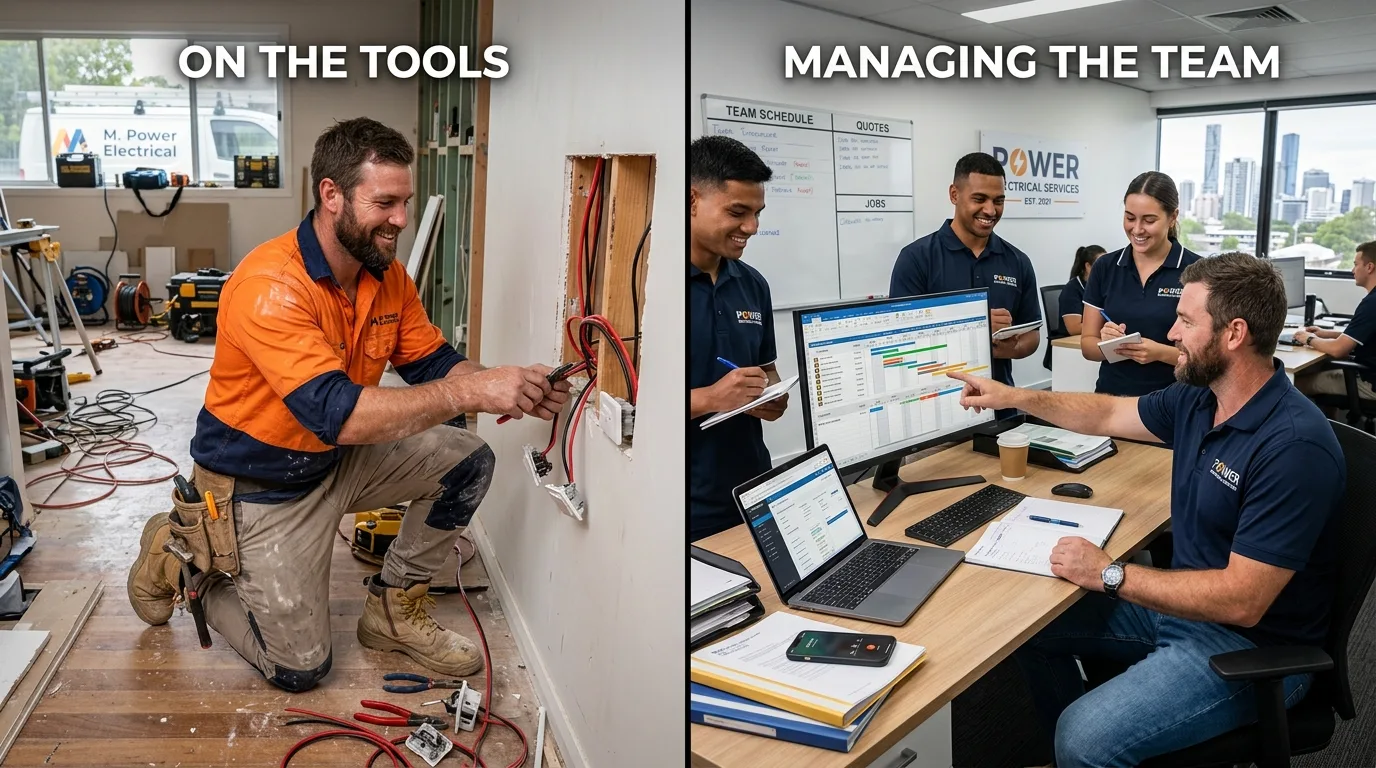
A tradie trades their time for money. A trade business owner builds systems and a team that generate revenue independently. You will still work hard — but the nature of the work shifts from doing to directing, from reactive to strategic.
Are You Ready to Hire?
Not every busy tradie is ready to hire — and hiring before you're ready is expensive. Run through this checklist honestly before making the call.
Don't hire a carbon copy of yourself. Hire to free your time, not to do the same job you do. Your first hire should take the lowest-value, most time-consuming tasks off your plate — so you can focus on quoting, sales, and growth.
Your First 90 Days With an Employee
The first three months determine whether the hire works or fails. Most tradies underinvest in this period, then wonder why the new person "just doesn't get it." Here's what a strong first 90 days looks like.
Days 1–30: Onboarding and Observation
Work alongside your new hire for the first month. Don't throw them in the deep end. Show them exactly how you do every task — from greeting a customer to how you leave a job site. This is where your SOPs get tested and refined. Every gap you find, document the fix immediately. Keep a running log.
Days 31–60: Supervised Independence
Start sending them to jobs without you, but check in daily. Review their work, debrief each day, and give direct feedback quickly. Problems left unaddressed in this window compound fast. Your CRM should be tracking every job outcome — use it to spot patterns early before they become habits.
Days 61–90: Full Productivity and Review
By day 90 your hire should be fully productive and independently managing their schedule. Review the financials: are you generating enough new revenue to cover the cost comfortably? If not, this is the time to intensify your marketing — not panic. Use this review to decide whether you need more work volume or whether a second hire is already on the horizon.
A solid rule of thumb: your hire should be generating 3× their cost in revenue by month 3. If a hire costs $8,000/month all in, you should be invoicing an additional $24,000+ per month as a result. If the numbers aren't there, the marketing needs to increase — see how to make your tradie business stand out.
Growing your tradie business from solo to team is not a single moment — it's a series of deliberate steps. The tradies who do it successfully are not necessarily the most skilled on the tools. They're the ones who invested in their systems, built their pipeline, and made the leap with a plan.
Ready to build the marketing system that supports your growth? Find out how Sora Business Solutions helps trade businesses across Australia scale from solo operator to thriving team.