SEO vs Google Ads: Which Is Better for Tradies?
"Should I do SEO or Google Ads?" — it's one of the most common questions trade business owners ask. And the honest answer is: both. But there's a right order, a right timing, and a right budget split. This guide gives you the full picture.
If you're a plumber, electrician, builder, roofer, or landscaper trying to grow your business online, you've likely been pitched both options. SEO promises free traffic and long-term results. Google Ads promises leads tomorrow. Both are true — but both have serious trade-offs that most agencies won't explain clearly.
This article breaks down exactly how each channel works in plain English, compares them across ten key criteria, and gives you a concrete strategy to maximise your marketing investment at every stage of your business.
SEO Explained (In Tradie Terms)
SEO — Search Engine Optimisation — is the process of making your business appear at the top of Google when potential customers search for services like yours. When someone types "emergency plumber near me" or "electrician Parramatta", Google scans thousands of websites and decides which ones to show first. SEO is how you convince Google your site deserves to be at the top.
For trade businesses, local SEO is the most valuable form. It covers three main areas:
- Google Business Profile (GBP) — your business listing in Google Maps and the local pack. This is often the fastest win for tradies.
- On-page SEO — optimising your website's pages with the right keywords, content, and structure so Google understands what you do and where you work.
- Off-page SEO — building your website's authority through backlinks, citations, and reviews. The more credible sources that reference your business, the more Google trusts you.
The big advantage of SEO is that once you rank, traffic is essentially free. A plumber ranking #1 for "plumber Sydney" might receive 400–800 visits per month from that single keyword — at no ongoing cost per click. That's the compounding asset that makes SEO so powerful over time.
The main drawback is time. SEO is a slow build. Most trade businesses see meaningful traction in 4–6 months and strong lead flow in 9–12 months. It also requires ongoing maintenance — Google's algorithm updates constantly, and your competitors are doing SEO too.
SEO tip for tradies: Your Google Business Profile is the single highest-ROI SEO task for most trade businesses. A fully optimised profile with regular photo uploads, responses to every review, and correct service area settings can generate significant leads on its own — even before your website ranks. Start there before anything else.
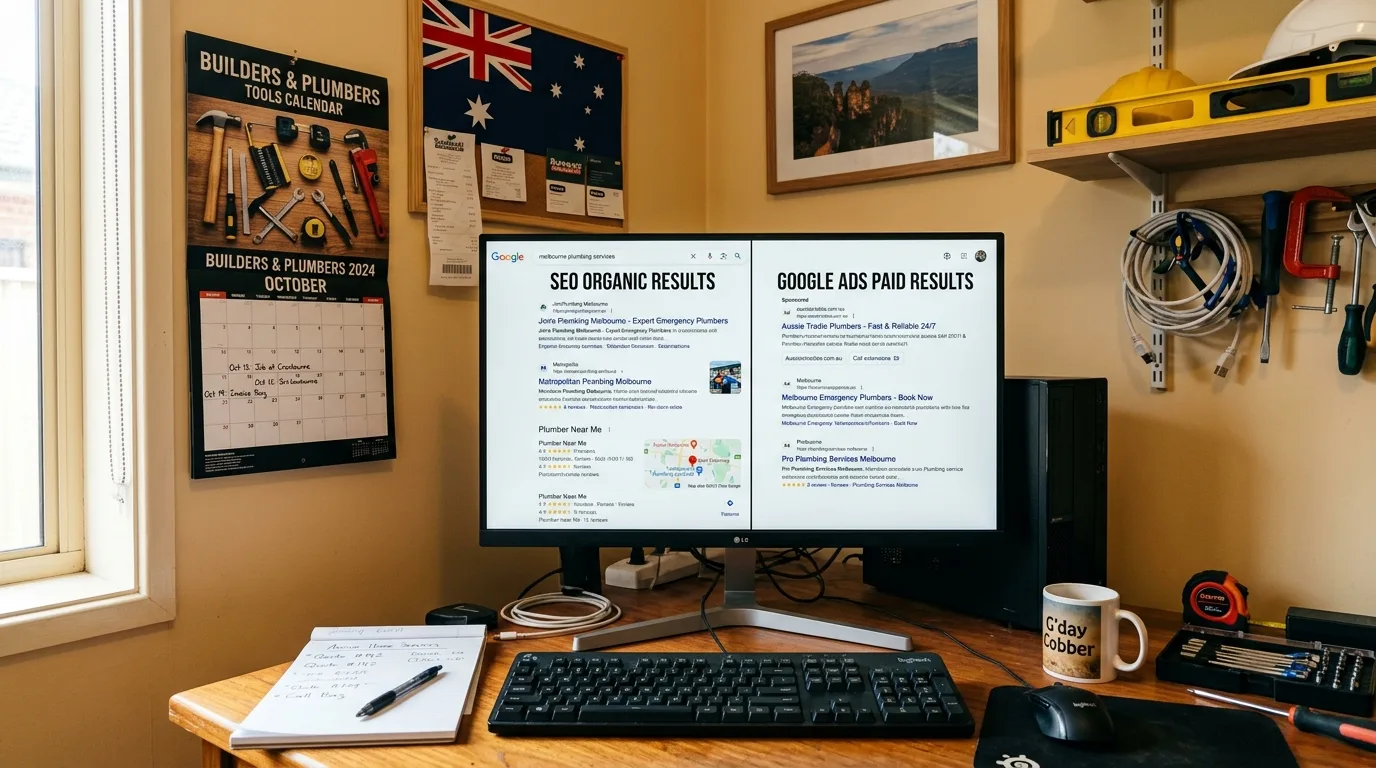
Google Ads Explained
Google Ads is a pay-per-click advertising platform. You bid on keywords, and when someone searches for those terms, your ad appears at the top of the page — above organic results. You only pay when someone clicks your ad.
For tradies, the most effective format is Search Ads — text-based ads that appear when someone searches for exactly what you offer. When a homeowner types "blocked drain plumber Brisbane", your ad can appear instantly — ahead of every organic result on the page.
The major advantage is immediacy. A well-set-up Google Ads campaign can deliver qualified leads within 24–48 hours of launch. There's no waiting 6 months for rankings to build. You're buying your way to the top of the page while your SEO develops in the background.
The trade-off is cost and dependency. Trade keywords are expensive — typically $15–$50 per click in competitive cities. And the moment you stop paying, the leads stop too. Unlike SEO, there's no compounding asset being built. You're renting visibility, not owning it.
Common Google Ads mistake: The biggest error tradies make is running broad-match keywords with no negative keyword list. This burns budget on irrelevant searches fast. Always run exact and phrase match, and exclude terms like "DIY", "free", "how to", "course", and "YouTube". A tight $1,500/month campaign will outperform a sloppy $3,000/month one every time.
Head-to-Head Comparison
Here's how SEO vs Google Ads stack up across every dimension that matters for a trade business:
| Criteria | SEO | Google Ads | Winner |
|---|---|---|---|
| Time to first lead | 3–9 months | 24–48 hours | Google Ads |
| Cost per click | $0 once ranked | $15–$50 per click | SEO |
| Sustainability | Traffic persists after work pauses (short term) | Stops the moment budget stops | SEO |
| Targeting precision | Limited — Google decides what you rank for | Full control — keywords, location, time, device | Google Ads |
| Trust & credibility | High — organic results feel more trustworthy | Lower — many users skip or distrust ads | SEO |
| Scalability | Slower — rankings take time to improve | Instant — increase budget, get more leads today | Google Ads |
| Asset building | Yes — rankings are a business asset | No — stops when you stop paying | SEO |
| Upfront investment | Higher time and content investment | Lower setup; higher ongoing spend | Tie |
| Complexity | Requires technical and content expertise | Requires campaign management expertise | Tie |
| ROI over 3 years | Very high — cost per lead drops over time | Moderate — cost per lead stays constant or rises | SEO |
SEO wins on long-term cost, trust, and sustainability. Google Ads wins on speed and targeting control.
When to Choose SEO First
SEO should be your primary focus when you're in a position to play the long game. Specifically, prioritise SEO when:
- You have an established business with a track record and existing Google reviews
- You're in a market with high ad costs and a limited budget for paid traffic
- You're building for long-term, sustainable growth rather than short-term volume spikes
- Your service area is defined and stable — local SEO compounds fastest with tight geographic focus
- You already have steady work coming in and want to reduce cost per lead over time
- Your competitors are ranking organically and you need to compete on a level playing field
For most established tradies, investing in SEO is the highest-ROI long-term decision they can make. A plumber who ranks #1 organically for 10 core service keywords in their city is generating leads at near-zero marginal cost — that's a powerful competitive moat that takes years for a competitor to break.
SEO prioritisation rule: If you have more than 3 Google reviews, a website that's at least 6 months old, and you're not entering a brand-new market — SEO should be getting a meaningful share of your marketing budget. Every month you delay gives competitors more time to build their authority advantage.
When to Choose Google Ads First
Google Ads should be your first priority when you need leads quickly and can't wait 6–9 months. Go to Google Ads first when:
- You're a new trade business with no existing online presence or reviews
- You've just launched a new website and have zero organic authority
- You're entering a new service area where you have no local reputation yet
- You have gaps in your schedule and need work booked fast
- You're testing a new service offering before committing to a long-term SEO campaign for it
- You're targeting very high-value jobs where a single conversion justifies high ad spend (e.g., full home renovations, commercial electrical work)
Google Ads gives you an immediate foothold. While your SEO is building, ads keep cash flowing. The key is to treat ads as a bridge — not a permanent crutch. Every dollar spent on ads while SEO is building is an investment in eventually reducing your cost per lead.
Don't wait to start SEO: A common mistake is thinking "I'll sort out Ads first, then do SEO later." The problem is, SEO takes 6–12 months to deliver. If you delay starting, you delay your payoff. Run both simultaneously from day one — even if your initial SEO budget is small.
The Smart Strategy: Use Both
The most successful trade businesses don't choose between organic vs paid search for tradies — they run both in a phased strategy that shifts the balance over time:
Google Ads runs at full budget to generate immediate leads and keep the pipeline full. SEO work begins in parallel: website optimisation, Google Business Profile set-up, foundational content, and citation building. Don't expect organic leads yet — you're planting seeds. Budget split: ~60% Ads / 40% SEO.
By months 9–18, your SEO delivers real leads from organic search and Google Maps. As organic volume increases, pull back ad spend for lower-competition keywords while maintaining ads for your highest-value or most competitive searches. Budget split: ~40% Ads / 60% SEO.
SEO now provides the majority of leads at near-zero marginal cost. Google Ads continues only for highly competitive terms, new service areas, or during seasonal volume spikes. Your cost per lead has dropped substantially. You own the asset now. Budget split: ~20–30% Ads / 70–80% SEO.
This phased approach gives you the best of both: fast leads today while building a compounding organic asset that delivers at lower and lower cost per lead over time.
How to Split Your Budget
For most trade businesses in Year 1–2, here's the recommended benchmark allocation for your digital marketing budget. These are starting points — adjust based on your market, competition, and growth stage:
On a $2,000/month marketing budget, that works out to roughly $800 on SEO, $800 on Google Ads spend and management, and $400 on reviews automation and Google Business Profile tools. This gives you short-term lead flow (ads) and long-term asset building (SEO), while keeping your reputation engine (reviews) always running.
Don't underinvest in reviews: Your Google reviews directly impact both your SEO rankings and your Google Ads conversion rate. A business with 4.9 stars and 80+ reviews will see more clicks, more calls, and a lower cost per lead across every channel. Reviews are the multiplier that makes everything else work harder.
The most important thing to understand: your marketing budget is not an expense — it's the primary lever for controlling how many jobs you win. Under-investing in digital marketing is the single most common reason trade businesses plateau. If your marketing spend isn't at least 5–10% of your target revenue, you're likely under-fuelling your growth engine.
Frequently Asked Questions
How much do Google Ads cost for tradies?
Trade keywords typically cost $15–$50 per click in competitive Australian markets. A managed campaign usually requires $1,000–$3,000/month in ad spend plus $500–$1,500/month in management fees. See our full guide on how much tradies spend on Google Ads for a detailed breakdown by trade and city.
How long does SEO take for a trade business?
Most trade businesses see meaningful organic traction within 4–6 months of consistent SEO work. Strong lead flow through organic search typically takes 9–12 months. Local SEO and Google Business Profile optimisation can show results faster — sometimes within 6–8 weeks for the Google Maps local pack.
Can I do SEO and Google Ads at the same time?
Yes — and this is the recommended approach. Run Google Ads immediately for fast leads while building your SEO foundation in parallel. Over 12–18 months, as your organic rankings improve, you can reduce ad spend and maintain strong lead flow at lower cost. The two channels also reinforce each other: Google Ads data reveals your highest-converting keywords, which you prioritise in your SEO content strategy.
Should I do Google Ads or SEO for my trade business?
For a new trade business with no online presence, Google Ads delivers the fastest results — leads within days. Start with ads immediately and begin SEO in parallel. If you're an established business with existing reviews and a working website, SEO should be your primary long-term investment. The ideal answer for most tradies is both, run simultaneously with a budget that shifts toward SEO over time.